Equity Markets
A Quarter of Opportunity
Fundamental analysis mattered this quarter, perhaps more than it has in three years. Investors in the AI/datacenter buildout were scared out of
their holdings and sold at unfavorable prices. This fear began with the announcement that Meta would sell some of its data center capacity. The market incorrectly deduced that this meant we had reached the peak of data center needs. A closer look revealed that offers from customers seeking compute capacity were simply too good for Meta to pass up, especially while it was still developing Muse.
Some names in the AI trade fell 50% in just a few months, despite reporting quarterly financial results far better than expected. This environment is perfect for fundamental investing, the approach we have used since 1987. By basing our investment decisions on financial statements and commentary from C-suite leadership, we were able to find something many participants didn’t…confidence. Markets, especially since the advent of Algorithmic trading, tend to “Shoot first and ask questions later”. This leads to increased volatility and extreme overreaction on both the upside and downside. Markets sold off swiftly and brutally, primarily because investors were afraid.
One of the best things an investor can do is remove emotion from their decision-making and focus on the cold, hard data. While markets may move on fickle investor sentiment in the short run, financial statements and a company’s fundamentals determine results in the long run. For the past three years, and going into the quarter, we were overweight to the AI/datacenter theme. As a result, the fear-induced drop prompted us to ask: what fundamental data would cause this level of apprehension?
After extensive research, we confirmed that the fundamentals were better than ever. Revenue growth was accelerating, margins improving, and supply chains loosening carefully. We therefore decided to hold and slightly expand our positions, given that prices for such favorable businesses were now too
good to pass up.
Since the end-of-quarter report season in mid-August, AI-related names have rebounded as investors return to trading on fundamentals rather than emotion. In other words, investors are starting to dismiss their fears, and the market is becoming more rational. The staggering opportunity was there. The ability to identify and act on it, and derive value from it, resulted solely from the ongoing fundamental analysis we consistently apply to our investment processes.
Results
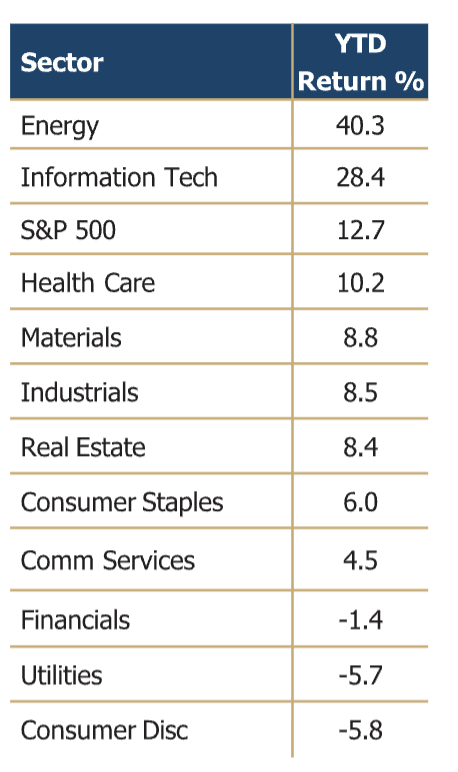
The third quarter of 2026 was a modestly positive one despite significant volatility. The US market was up 2.3% and international markets up 0.5%. This follows several quarters of above-average positive returns, primarily driven by the technology sector. This quarter, technology continued to outperform alongside communications, energy, and healthcare.
Reasons for outperformance:
• Energy: Oil price increases were the main reason, as a result of the US/Iran war. Brent crude (the benchmark most closely tied to international markets) was up 35% in the quarter. Refiners were the largest beneficiaries as pricing spreads between input and output fuel (crack spreads) widened, especially for diesel refining.
• Technology: Performance was sluggish for the first two months of the quarter as investors grew concerned about the AI trade given its rapid rise over the first six months of the year. A recovery began after quarterly earnings were released, showing strong fundamentals, and extended following the rollout of agentic AI, largely from Meta’s Muse platform.
• Healthcare: An unlikely participant; the sector rose as a result of encouraging results from a new individualized cancer drug developed jointly by Moderna and Merck. This drug was new in its approach as it was tailored to match the DNA mutations of each individual patient. This differs from the one-size- fits-all approach common in traditional pharmaceuticals. The bullish case is that individualized medicine will drive more lab and diagnostic work and, of course, more powerful medicines.
• Communication: Gains were almost entirely driven by performance of Meta, which represents roughly 22% of the sector. As you will read in the letter on fixed income markets, rising interest rates were a new concern introduced during this quarter. The effect of rising interest rates on the stock market was seen during the quarter in the following examples:
• Home builders’ stocks were hard hit as higher mortgage rates led to fewer transactions
• Materials, engineering, cement, and industrial firms tied to the construction market were hit as higher interest rates usually lead developers to pause projects.
• Dividend payments are a major driver behind investor interest in utility, real estate, and consumer staples stocks. The dividend yield (annual dividend payment per share divided by price per share) acts like a coupon payment and is therefore tied to interest rates. Given a stable dividend payment, mathematically this means stock prices usually fall to keep the dividend yield competitive with bond yields.
Valuation Update
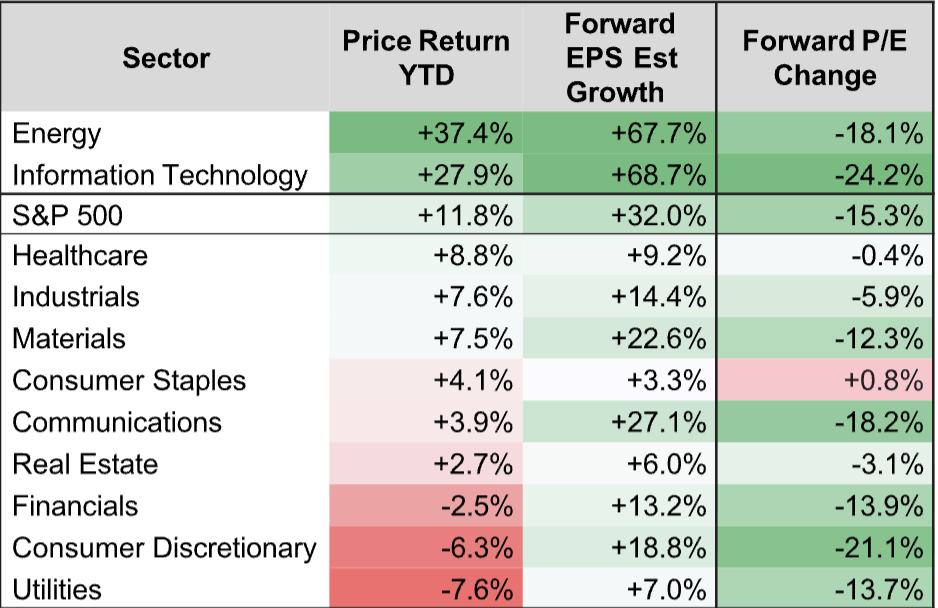
Given how much bond yields have risen recently, it is natural to ask whether tilting a portfolio slightly toward the bond side would be wise. Bonds have become cheaper as rates have risen, but in a twist, the equity market has gotten cheaper too; see chart on the following page. The most common approach to valuing a stock is the Price-to-Earnings (P/E) ratio, which divides a stock’s price per share by expected earnings per share over the next 12 months. The P/E multiple shows how much investors are willing to pay for each dollar of earnings.
While the positive year-to-date (YTD) price returns are impressive, the larger move was in earnings expectations. For example, the technology sector has risen 27.9% YTD, but rolling next 12 months earnings expectations have risen 68.7%, which has led the multiple to contract by 24.2% compared to
the beginning of the year.
Investors often focus more on price movements, leading many to see such a rise in technology and think “this has gone up too much too quickly”. Recognizing the rare case that earnings growth was much higher than price growth indicates the exact opposite. Of course, one must believe that the earnings growth estimates are appropriate and won’t fall dramatically. Both financial statements and comments from C- Suite executives support a view that investments in AI will continue to accelerate in the coming years.
Fixed-Income Markets
In June, the Memorandum of Understanding establishing a 60-day ceasefire to end the conflict with Iran was announced, raising expectations of a resolution, lower energy prices, and declining interest rates. Market concerns about the stickiness of higher energy prices since the war’s inception in February began to wane, but given the on-again, off-again nature of the conflict, the positive emotions were overdone.
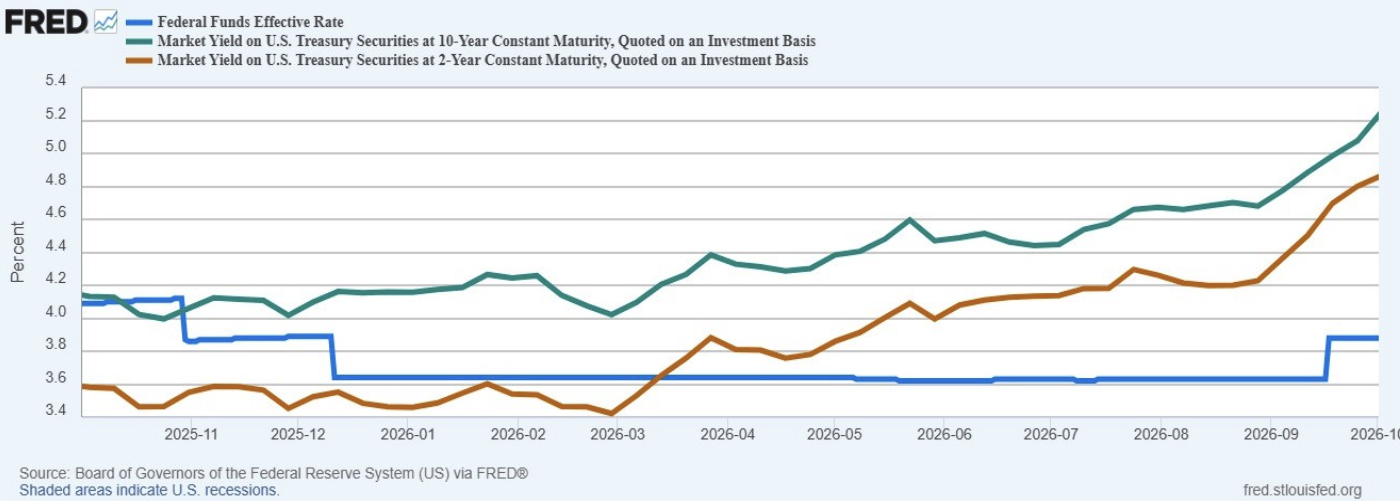
In early August, however, following the resumption of Iranian drone attacks on shipping routes, those same concerns were back on the table. It became increasingly clear that we risked higher energy prices that would soon be anything but transitory. In response, we shortened our portfolios' weighted average life relative to our benchmarks to minimize the pain of higher energy prices driving interest rates back up. By the end of the quarter, the 2-year USTN increased from 4.15% to 4.89%, and the 10-year USTN rose from 4.43% to 5.29%, the highest point in nearly 20 years. Now, with the previously positive emotions in remission, negative emotions reflected in higher yields had run too high, and we lengthened the weighted average life to match our benchmarks.
Interest rate moves this sharp have produced negative returns for bond benchmarks. Even so, our collective decisions in managing through these rate changes over the year limited negative returns to a small fraction of our benchmarks’ returns. More importantly, these same interest rate moves set the stage for even more attractive yields and better bond returns going forward.
Multiple factors are contributing to higher interest rates, including a strong economy, US Treasury borrowing surging past $40 trillion, the pace of annual corporate debt issuance doubling to $3 billion since the start of 2024, and higher inflation driven by higher energy prices, the last providing the most direct impact. Inflation has run too high for too long, above the 2% target for 65 consecutive months. And while multiple factors are responsible, energy is the biggest and most recent input keeping a firm floor under prices. It’s no surprise that since the war with Iran started in February, the correlation between oil prices and US interest rates has doubled compared to its usual relationship; as oil prices go, so too will interest rates.
When the FOMC met on September 16-17, it voted to increase the overnight rate to 3.75-4.00%, which Federal Reserve Chair Kevin Warsh framed as “removing a dose of accommodation”, and markets currently project another three increases over the next nine months. The chart above shows the recent progression of 2- and 10-year USTN yields, and it’s clear the Fed had little choice but to move. The challenge is that, with inflation data so heavily impacted by higher energy costs in 2026, raising interest rates may have little effect on prices until hostilities with Iran wrap up, a timing the
FOMC cannot control.
The longer energy prices stay elevated, the stickier they become, and the more deeply they work their way across the broader economy. Evidence of that transition has grown over the quarter. In addition to rising food costs and technology costs mentioned in last quarter’s letter, a 77% increase in diesel prices over the last year is driving up transportation costs across the board for trucking, railroad, parcel-delivery, and waste management companies nationwide.
These additional costs are showing up in a growing list of final selling prices. Nevertheless, the economy continues to expand despite higher prices. After exceeding 2% growth in the first and second quarters, the Federal Reserve Bank of Atlanta’s GDPNow tool estimates Q3 growth at 3.7%, and we don’t see any recession risks over the next 6-12 months. Data releases show that employment remained stable over the quarter and people continued to spend freely. The silver lining is that bond market conditions are creating some of the most enticing opportunities in a long time for bond investors, and we argue for investing some of the excess cash balances investors have stockpiled.
The main risk we see is that the FOMC tries to bludgeon energy-driven inflation downward by pushing interest rates too high.
Disclosure: This is for informational purposes only, and any reference to a specific company or type of security does not constitute a recommendation to buy or sell that company or security. The reader should not assume that an investment in the security identified or described was or will be profitable. For a complete list of disclosures, please click https://mitchcap.com/