Equity Markets
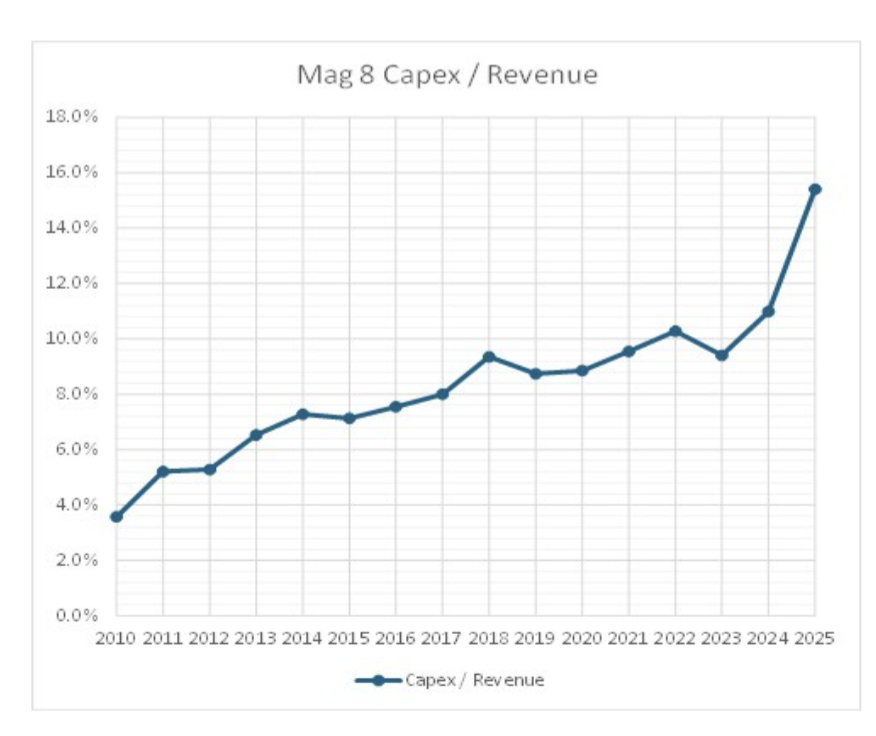
Global equity markets completed their third year of strong gains, with the international markets broadly outperforming the US equity market. Economic growth remained on an expansionary path; global inflation moderated; and consumers, supported by a solid employment market, continued to spend at a steady pace. Market leadership shifted as healthcare, a lackluster sector for most of 2025, delivered the best returns over the quarter, while AI and data center investments underperformed. We expect 2026 to deliver normal equity returns (+8% to +10%) driven by robust economic growth, lower interest rates, moderating geopolitical tensions, and further easing of global tariffs. MCM equity strategies delivered solid absolute returns in 2025. Still, they underperformed in the final two months as investors began to question how fast AI profitability would arrive broadly, pushing stock prices down from recent highs. As we enter 2026, we remain committed to the AI investment theme and expect to increase our already overweight position, either through new purchases at lower prices, market appreciation, or both. AI success stories aren’t limited to the future; they already include applications in advertising and data analytics, robotics, security software, healthcare, and driverless vehicles. Many more opportunities will arise over the coming years across various industries that we cannot anticipate today.
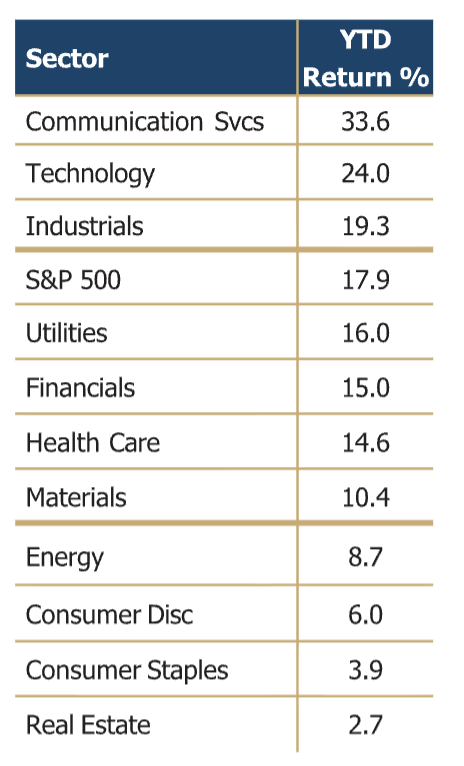
Demand for processing power already exceeds supply; current data centers are operating at full capacity. This is no ‘build it, and they will come’ investment cycle. ‘They’ are already here. CEOs are committing billions in capital expenditures (see graph) to increase their exposure to the growth trend and their ability to capture new and growing revenues. Capital expenditures as a percent of revenue ran at a steady 10% from 2018 through 2023, but have accelerated in the last two years as CEOs see data center demand rising and profitability improving.
We believe that the commercial applications of artificial intelligence are only beginning to emerge. That our economy will look very different in the next five or ten years, and that companies supporting the infrastructure buildout (in the short term) and developing productive, cost- effective applications (in the long term) will reap the benefits through increased profitability.
As with previous technologies, this evolution won’t happen quickly, with periods of reassessment like the one we’re in now. We have moved past the initial curiosity and optimism that began with the introduction of ChatGPT in late 2022, entering a period of growing skepticism and caution as spending increases, competitors emerge, and investors begin to ask hard questions about how new revenues will offset prior investments. This will likely reveal some fear and disappointment as supply constraints slow data center construction, technical challenges develop, or market response for new applications is weaker than anticipated.
Beyond this, we expect a period of new optimism and renewed confidence as commercialization efforts succeed. While our conviction in the long-term commercial opportunities in AI and data center construction remains intact, we have adjusted our overall allocation as market prices have shifted. For most of the year, our portfolios reflected a greater exposure to AI and data center companies as high as 15% (relative to our market benchmarks). We lowered that to 10% during Sept-Oct, primarily trimming positions that had grown well beyond our value estimates.
As mentioned in the third-quarter letter, we anticipated periods of lackluster growth, most likely because we could not secure construction projects that are zoned, approved, and physically built. We expected this bottleneck to arrive within a year, but constraints surfaced earlier as construction supply bumped up against full capacity. While the Nov-Dec underperformance reduced the overweight position to approximately 8%, we expect it to be short-lived. Technological advancements have had varying impacts on employment opportunities, cost structures, employee and operational efficiency, employment gaps, and the creation of new roles. AI is no different and is much more than merely a cost-cutting or job-replacing tool. The World Economic Forum projects 92 million jobs will be eliminated by 2030, with another 170 million being created. This transformation will reduce repetitive tasks while creating new roles focused on strategy and problem-solving, tasks at which humans excel.
The real challenge isn’t just job numbers; it’s the gap between where jobs retreat and where they emerge, and between the skills workers possess and the skills new roles require. Healthcare re-emerged during the quarter as an investment theme, as investors seek stable growth opportunities and new pharmaceutical discoveries despite a large and growing government payer base and increased regulation. Population demographics have driven increased use of health care services over the last decade, a trend we expect to continue as demand rises for home-based care, senior living facilities, and surgical procedures. The sector is an essential part of our diversification strategy, but we remain market- neutral given regulatory and payer headwinds.
We remain focused on monitoring investment themes, looking for new trends, and adjusting our views on individual companies as valuations evolve or business fundamentals change. We look forward to discussing the stock market, the economy, and shifting employment opportunities in our upcoming meetings.
Fixed Income Markets
2025 was a great period for fixed-income investors, with our bond strategies delivering the strongest performance in over 15 years. Tailwinds included a decline in the 10-year US Treasury yield, driven by strong investor demand and expectations of lower rates, along with volatility around the effects of tariffs first announced in April. A large portion of our success can be traced to decisions made to manage interest rate sensitivity by adjusting the weighted average life of our portfolios through the year. While the 10-year US Treasury yield peaked at 4.79% in January and sank to 3.95% in October before settling at 4.17% by year-end, we took steps to lengthen or shorten portfolio average lives in April, July, and August to take advantage of where we thought rates were headed. The timing of these decisions helped boost returns beyond portfolios built to replicate market returns.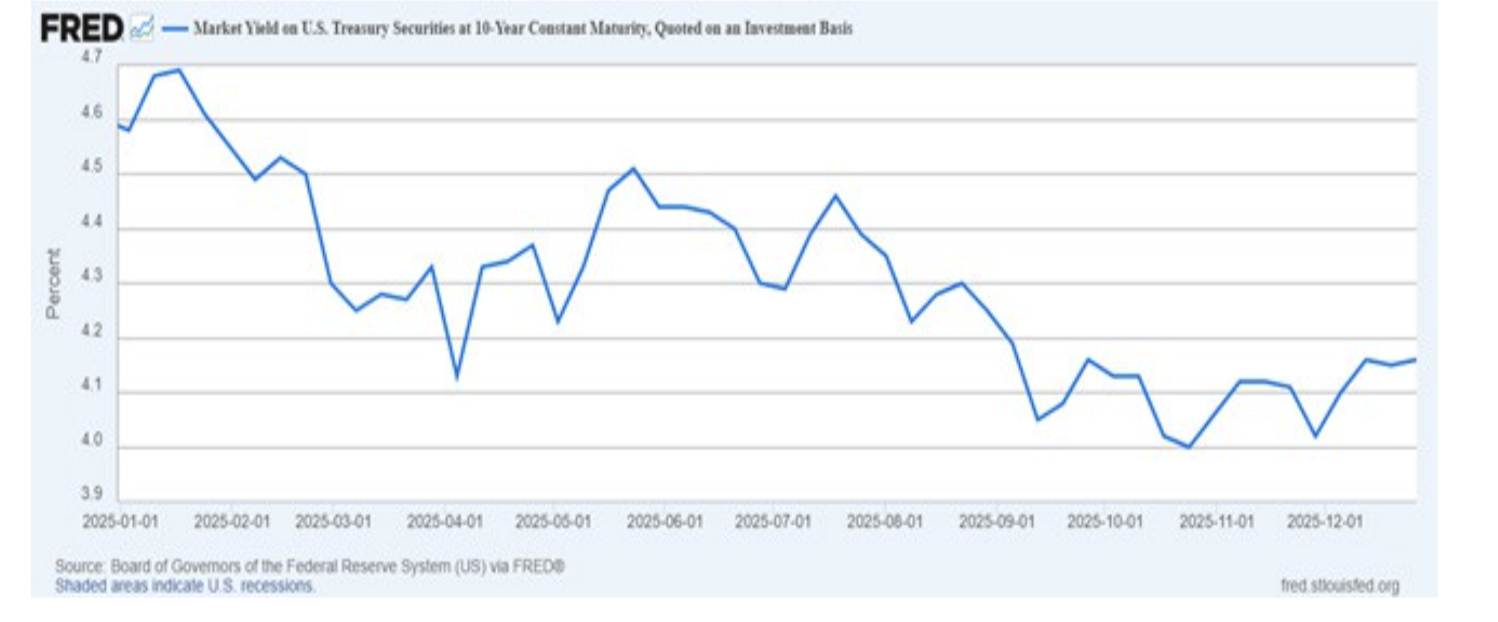
As 2026 unfolds, conditions are essentially unchanged, and we see multiple reasons for optimism heading into the new year. Financial conditions are set to continue easing. The Federal Reserve’s monetary policy stance remains firmly oriented toward lower rates over the next 12 months. In September, having instituted a collective 1.0% reduction nearly a year earlier, FOMC voters voiced growing concerns about slowing job creation. Despite a decline in the inflation rate that appears to have stalled due to tariff burdens, rates were lowered by another 1.0%, with projections showing another 1.0% expected over the coming 12 months. Further, a new FOMC Chairman will be installed in May, though his appointment will likely be announced in January; his outlook is more aligned with the current administration’s view that rates should be much lower than they are today.
The administration is focused on economic expansion. Whether through lighter regulatory hands across the economy (cryptocurrencies, stablecoins, AI, banking, energy, etc.), pressing for lower interest rates, or incentivizing investment in domestic manufacturing through tariffs and trade agreements, the administration is taking an all-of-the-above approach to grow the economy and address affordability concerns before the mid-term elections next November.
Real economic growth (in excess of inflation) remains positive. Despite the costs and disruption of tariffs and other headwinds, businesses found a way to meet consumer needs and maintain profitability. Based on economic growth and second- and third-quarter earnings announcements, things are improving.
Even so, risks remain prevalent. Tariffs were expected to do more damage. The fact that they haven’t yet doesn’t mean they won't if more costs are passed through or adequate substitutions cannot be made.
Inflation isn’t finished yet. CPI hasn’t met the Federal Reserve’s 2% inflation target since 2022 and isn’t forecast by the FOMC to do so again until 2028. It wouldn’t take much to push it up again, and higher daily costs of living for more citizens may make much of the economic
growth less effective as an election topic.
Disclosure: This is for informational purposes only, and any reference to a specific company or type of security does not constitute a recommendation to buy or sell that company or security. The reader should not assume that an investment in the security identified or described was or will be profitable. For a complete list of disclosures, please click https://mitchcap.com/