
Equity Markets
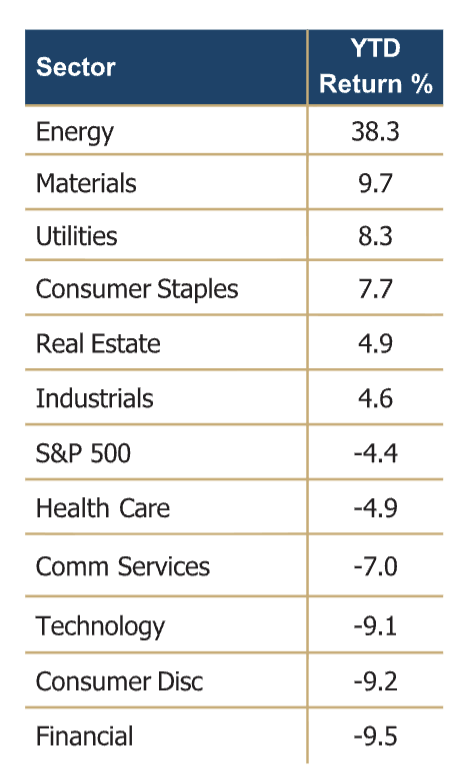
The first quarter of 2026 can be broken into two distinct periods: before and after the outbreak of the 2026 Iran war.
Prewar [January 1 – February 27]:
Before the war broke out on February 27, international markets (up 11.3%) continued to outperform the US (up 0.7%). Software stocks sold off broadly (falling 22%) as updated versions of AI platforms demonstrated surprisingly impressive coding abilities. The developers of these platforms prioritized coding as the first area of expertise for AI because strong coding skills would enable models to rewrite themselves and improve at a seemingly exponential pace.
Many highly seasoned software engineers were finding that these new AI models were just as skilled as they were. This transformation shows how quickly new technology can shift market sentiment. Software stocks have long commanded high valuations because of their high margins and low cash needs, but these strengths may erode as AI coding advances. Memory chip-producing companies were a blindingly bright spot in January, as prices for the densest memory chips rose by nearly 70% amid the AI market’s shift from training to inference. Training refers to the learning that AI models undergo to become sufficiently accurate at answering questions by providing large amounts of data and instructing them to identify patterns.
The training phase placed more emphasis on sophisticated Graphics Processing Units (GPUs) that could act as intelligent pattern identifiers. Now that models have become relatively well-trained, we have moved to the inference stage, which requires far more memory. While training uses a relatively fixed amount of data, inference creates more. Every question and response is stored so that subsequent questions can be answered more accurately. This results in a rapid increase in user-specific data that must be stored. A key bottleneck in the inference stage is minimizing wait time. Inference uses the fastest GPUs, which require High Bandwidth Memory (HBM) built for inference applications and the fastest cable structures available.
Operators of expensive data centers can’t afford even a nanosecond of downtime while these costly GPUs wait for data, and chipmakers are responding with faster components. For example, the newly created Nvidia Rubin platform houses about 3 times the memory bandwidth as its previous Blackwell platform. HBM requires about 3x the bit size of conventional memory chips, and this high density is at a premium for AI customers. Demand for these products is far outpacing supply.
Wartime [February 28 – March 31]:
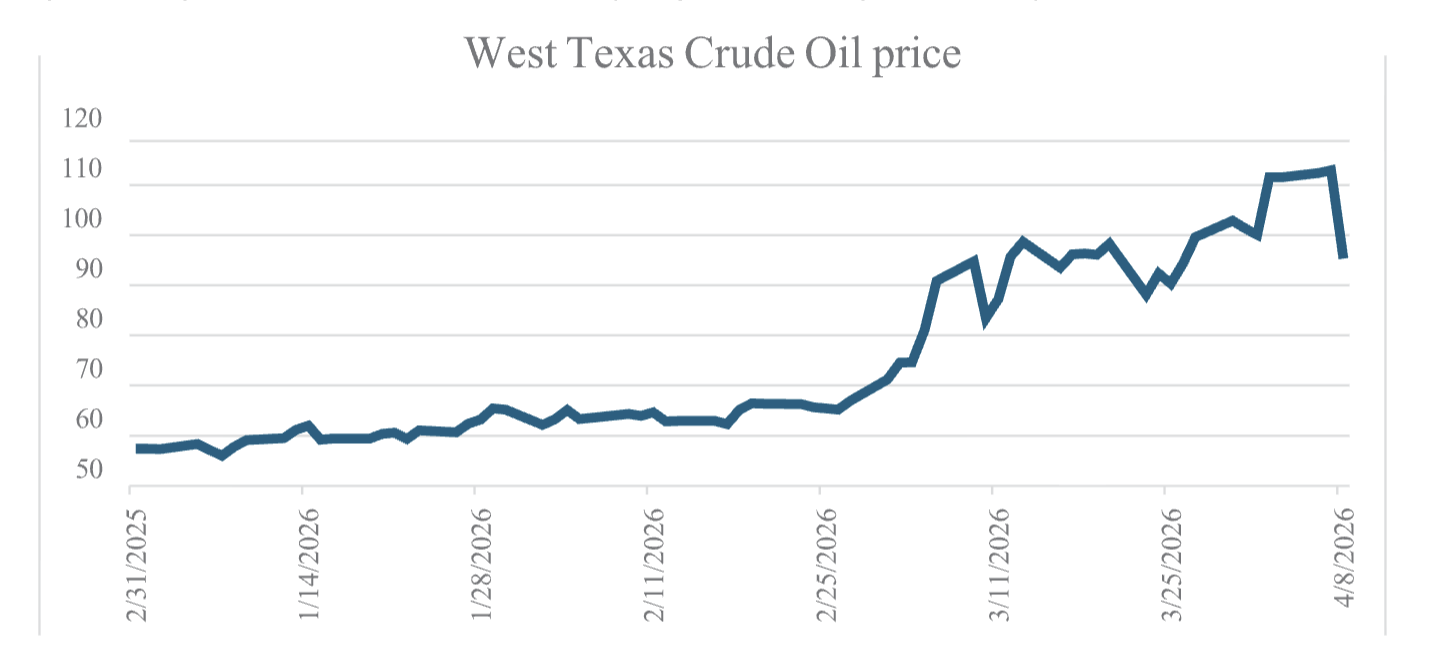
On the evening of Feb 27th, the outbreak of the war in Iran was announced, sparking market worries. As the conflict became more entrenched and damaged energy infrastructure, the market tipped into correction territory for the first time since April 2025, when the Trump administration announced new tariffs. While the US is a net exporter of energy products, the war highlighted the global nature of energy prices, as the Strait of Hormuz effectively cut off the transport of 20% of the global oil supply. The implications of this disruption were immediately seen in market reactions: Brent Crude prices jumped
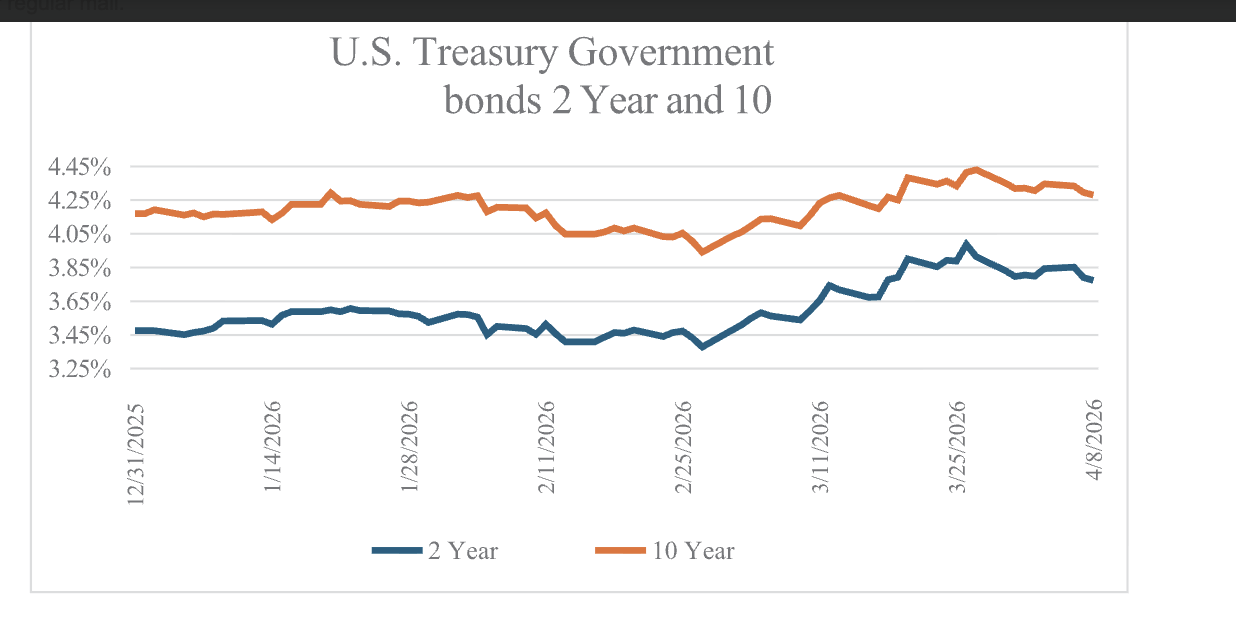
from $70 to $110 a barrel, and interest rates around the world rose, with the US 10-year going from 3.95% to 4.43% over the following weeks. Consumer discretionary stocks fell as higher inflation, driven by energy price increases, would constrain the consumer’s capacity to spend on clothing, travel, food, automobiles, and homes.
Financial stock prices fell amid similar consumer-related concerns and fears that higher interest rates would suppress the robust mergers-and-acquisitions activity that has propelled investment banking transactions well beyond all-time highs. Company boards often pause deal negotiations amid extreme volatility (such as the outbreak of war), which can pressure investment bankers’ bottom lines. Counterintuitively, technology stocks related to the data center and AI buildout did not fall at first, stemming largely from the belief that demand for data center construction was inelastic, or unaffected by surrounding events, as CEOs had the cash and resolve to continue this multi-year investment theme.
This initial resilience was tested, however, in the final week of the quarter as a pervasive and irrational fear swept the industry. Since the start of the war, international markets fell more (-8%) than US markets (-5%). Given the US’s status as a net energy exporter, the performance difference is understandable. We used this as an opportunity to increase international financial exposure.
Addendum [post-quarter-end]:
As the market learned nearly a year ago from presidential tariff increases, markets can swing rapidly in both directions in a matter of hours based on the communications of just one person. Since the end of Q1, the market has become more volatile. However, the start of Q2 has seen positive volatility, with the
market approaching pre-war levels amid emerging cease-fire talks and the perception that the war is winding down.
Where do we go from here?
The next few weeks will focus on how the peace talks progress, how much higher inflation numbers get, and, of course, the start of quarterly earnings season. During the war month of March, we maintained the overall portfolio risk profile and data center/AI exposure. Now that the war has calmed and those AI names are hitting all-time highs again, we will likely seek to marginally reduce our risk profile if this bullish move starts to slow.
Fixed Income Markets
During the first two months of 2026, the bond market reflected a solid economic backdrop, consistent with a narrative of contained inflation, steady job growth, and an economy expanding at roughly a 2% annual pace. The expectation was that the Federal Reserve would lower the overnight rate two to three times during the year.
That picture changed abruptly once the war began on February 27. The closure of the Strait of Hormuz and broader disruptions across Middle Eastern supply chains pushed crude oil prices sharply higher, introducing a new inflation shock into the global economy. As energy markets repriced, expectations for Federal Reserve policy shifted. Oil peaked on April 7 at $115/ barrel.
The conflict has shifted the economic narrative from a soft-landing outlook to one dominated by inflation risk, prompting a rapid adjustment in the bond market. In one month, expectations for central bank policy flipped, turning from an outlook for additional rate reductions to a view that the Federal Reserve would hold rates steady, or possibly raise them.
The bond market is increasingly focused on inflation pressures stemming from the conflict in the Gulf and, more recently, on the possibility that elevated inflation could persist not just for a few months but through the end of the year and beyond. While corporate earnings forecasts remain strong, the
longer-term growth implications are only now entering the conversation.
The 2-year US Treasury yield rose to 4.0% as traders removed near-term rate cuts from their outlook. Long-term yields also moved higher, with the 10-year yield reaching 4.43%, reflecting higher inflation expectations and a reassessment of the risks ahead.
Despite the rapid change in sentiment, major uncertainties remain: how long the fighting will continue, how long the Strait of Hormuz will be effectively closed, what level of hostilities might follow a ceasefire, and the extent of damage to energy infrastructure and ports across the Persian
Gulf. Until these questions become clearer, market volatility is likely to persist. Looking towards the end of the year, markets will continue to feel the residual impact of the conflict with Iran. Elevated energy prices will likely introduce secondary inflationary effects across the US economy, keeping higher price pressures sticky. In this environment, the Federal Reserve faces a challenging policy landscape, narrowing the window for any potential interest-rate reduction for the remainder of 2026.
Disclosure: This is for informational purposes only, and any reference to a specific company or type of security does not constitute a recommendation to buy or sell that company or security. The reader should not assume that an investment in the security identified or described was or will be profitable. For a complete list of disclosures, please click https://mitchcap.com/