
Equity Markets
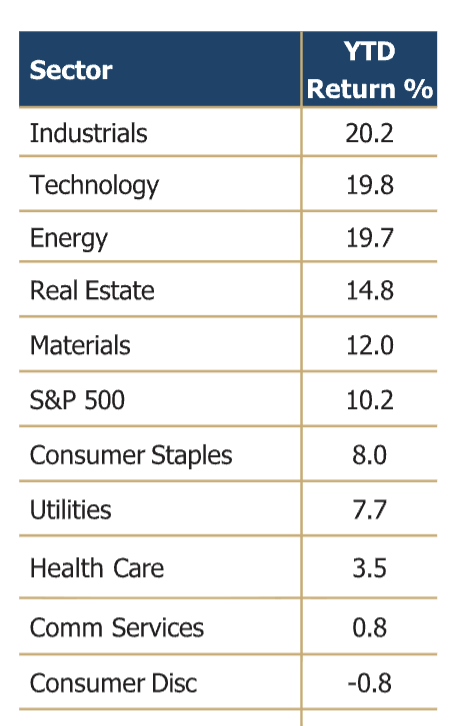
Throughout the second quarter, both the S&P 500 and the Morgan Stanley All-Cap World indexes gained 15%. We began to see the market broaden (with more sectors and companies participating in the advance) as small- and mid-cap equities outpaced their large-cap counterparts, while the Health Care, Industrial, and Financial sectors posted solid returns toward quarter-end. The on/off war with Iran continues to dominate headlines and affect energy prices. We are closely monitoring the impact on inflation to determine whether the effects are long-lasting. Meanwhile, the US economy remains resilient, employment growth is stable, consumers continue to spend, and corporations continue to invest for future growth, supporting our outlook for solid returns through the remainder of 2026. Revenues and earnings will continue to grow, the US election will most likely produce gridlock again, and several high-profile IPOs (Initial Public Offerings) from Anthropic and OpenAI will be completed. We have identified solid investment opportunities in the Consumer Discretionary, Health Care and Financial sectors. Consumer Discretionary stocks are highly correlated with energy prices and interest rates. New additions include cruise lines, retail and travel, and online travel agencies. If the war in Iran is settled, oil prices will remain in the $70/barrel range after spiking above $100/barrel. Lower oil and gasoline prices will put more cash into consumers’ hands and lower costs for travel-related companies such as airlines and cruise lines. Baby boomers have led the spending charge, as higher investment portfolio values and fixed-income returns have provided ample funds to travel and enjoy life.
Baby boomers are also spending more on health care. Demand for services such as senior living, assisted living, and pharmaceutical management services is growing. We’ve added new positions in the pharmaceutical management services arena while we continue to analyze senior living options. The US government remains a major payer, so we are focusing on investment opportunities that serve healthier/wealthier individuals who pay for those services out of their savings and are less dependent on fluctuations in reimbursement rates from Medicare or Medicaid.
Financial companies have also benefited from consumers getting a break from falling gasoline prices and from higher stock and bond portfolios. We’ve increased investments in banks and prime credit card companies that focus on higher-end credit quality consumers. A stronger consumer should indicate a
healthier loan portfolio. Higher stock and bond portfolio values positively impact investment management fees and services. Data center and AI growth remain an important focus of our investment strategy. Recently, the market has favored companies that earn revenue from data center builders, such as construction, on-site electricity generation, optical transmission, semiconductor, and semiconductor equipment companies.
The “Mag 7,” which has led the market over the last few years, continues to grow its revenues, earnings, and capital expenditures. However, their stocks are consolidating (moving sideways/slightly down), making way for smaller companies to lead the market. Investors are concerned about when all the spending will translate into higher cash flows and earnings. As technology advances and data centers become more efficient, profitability will increase. The timing is difficult to predict, as they are still in the early stages of the buildout.
Several communities are questioning the need for data centers in their backyards (NIMBY), as water and electricity consumption is driving rates higher. Data centers are responding by building dedicated electricity generation capacity and investing in closed-loop systems to use less water. Amazon recently announced its water consumption for 2025, using about 2.5 billion gallons of water last year, which is about 5% of the water Seattle uses annually. That represents a 2.5% decline from the prior year, despite having built more data centers. They are becoming more efficient, using wastewater, and aim to return more water to communities by 2030. Your portfolio is invested in power generation and cooling companies that are helping data centers achieve their growth objectives while improving environmental impact and community relations.
We remain focused on monitoring current investment themes, looking for new trends, and adjusting our views on individual companies as valuations evolve or business fundamentals change. We look forward to discussing the stock market and economy in our upcoming meetings.
Fixed Income Markets
On February 27, one day before the outbreak of the war with Iran, we reduced our weighted- average portfolio life from 6.0 years to 5.0 years, expecting higher oil prices to have an unknown degree of impact on economic activity. As the war dragged on over the next month, bond market expectations for multiple Federal Reserve rate reductions dwindled to one by the end of March. Energy prices rose as the war continued, raising inflation concerns first in everyday transportation costs and then in secondary effects on other products and services. Concurrent data releases showed that employment remained stable and people continued to spend freely, calling into question the need for and the wisdom of lower rates and instead increasing the odds of rate increases. In response, we reduced our weighted-average portfolio life in early April from 5.0 years to 3.75 years, and again in mid-April to 2.75 years, before the FOMC met later that month.
In June, the day before the Memorandum of Understanding establishing a 60-day ceasefire was officially announced, we extended its weighted life to 3.75 years, believing rates had peaked. These combined decisions helped us outperform our benchmarks over the quarter. We now carry a weighted-average portfolio life similar to our bond market benchmark and will review the data before making further adjustments. Inflation remains the wildcard, but for changing reasons.
Year-over-year headline PCE (the measure favored by the FOMC) was 4.07% as of May 2026; last year at this time it was 2.46%. Core PCE (stripping out volatile energy and food prices) was 3.41% in May 2026. Last year it was 2.78%. As it now stands, we have likely hit peak headline inflation. With oil prices back at pre-war levels, inflation should ease considerably toward the 2% target.
As energy-driven inflation decreases, other factors are emerging. With the war lasting longer than expected, secondary effects may still materialize as producers raise selling prices to cover the costs of inputs sourced from high-cost suppliers. Food prices continue to rise, constrained not only by energy costs but also by other reasons, including trade tariffs, high labor costs, and corporate pricing strategies. The same drivers that are exciting stock investors in the buildout of AI data centers (higher selling prices) are also increasing technology costs due to competition for memory and
processing chips.
At his first press conference last month, new Federal Reserve Chairman Kevin Warsh announced the creation of five new task forces designed to ask uncomfortable questions: Fed Communications (are they talking too much), the Fed’s Balance Sheet (is it too big), Data Sources (are the favored data
points too backward-looking), Productivity and Jobs (what is the impact from AI), and Inflation Frameworks (are they measuring, analyzing, and reacting to it appropriately).
The answers to these questions will have major implications for how the Federal Reserve interfaces with market participants. The task forces will meet through the end of the year, so any decisions are months away. However, Chairman Warsh has already put his stamp on institutional practices, cutting the length of the post-meeting press conference, sharing much less detail than his predecessor in his responses, editing the press release to one-third the usual length, and holding back his ‘dot’ on the Summary of Economic Projections. Small changes, to be sure, but initial steps in what will be a larger philosophical shift.
Disclosure: This is for informational purposes only, and any reference to a specific company or type of security does not constitute a recommendation to buy or sell that company or security. The reader should not assume that an investment in the security identified or described was or will be profitable. For a complete list of disclosures, please click https://mitchcap.com/